 If
you're a fan of Disney theme parks like I am, your biggest curiosity about Tokyo
Disneyland Park is probably how it compares with the American Disney parks. The
answer is: it's very similar, and it's very different.
If
you're a fan of Disney theme parks like I am, your biggest curiosity about Tokyo
Disneyland Park is probably how it compares with the American Disney parks. The
answer is: it's very similar, and it's very different.
The biggest difference is probably the most obvious: Tokyo Disneyland Park is located in Japan. Most of the dialog in the rides and attractions is in Japanese. All signs, restaurant menus, etc., are printed in Japanese (although they all include English translation in small print). Almost all of the employees are Japanese. In keeping with Japanese tradition the employees (or "cast members" as they are called) have their last names engraved on their name tags, although someone unfamiliar with Japanese names will likely be oblivious to this fact. And unlike the American parks which see many visitors from all over the world, almost all of the guests you'll see in Tokyo Disneyland Park are Japanese.
One big feature of Tokyo Disneyland Park is that it's big—about 114 acres. Compare that with Disneyland Park, which is 74.2 acres, and the Magic Kingdom in Florida which is 106.3 acres. Despite its larger size, Tokyo Disneyland has fewer rides and attractions—I counted 45 rides and attractions at Tokyo Disneyland, versus 58 at Disneyland in California. Much of the park is open space, seemingly designed to hold as many visitors as possible. During the busy summer months it's not uncommon for the park to open its doors in the morning, then have to stop admitting visitors around noon because it is filled to capacity (about 85,000 guests). The doors reopen again around 5:00 PM. The park can see over 100,000 visitors a day.
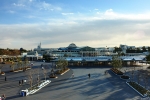
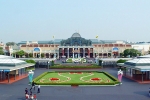
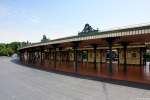
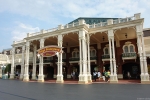
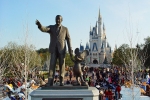
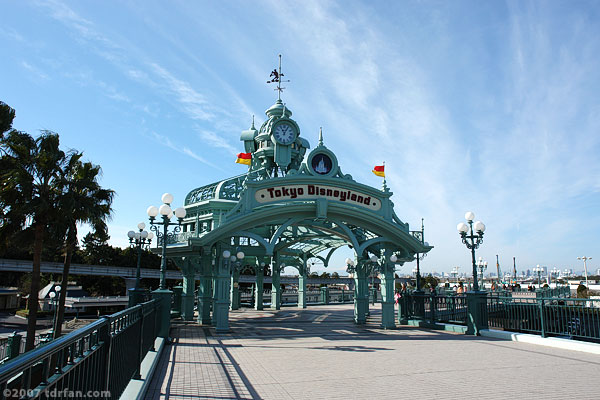
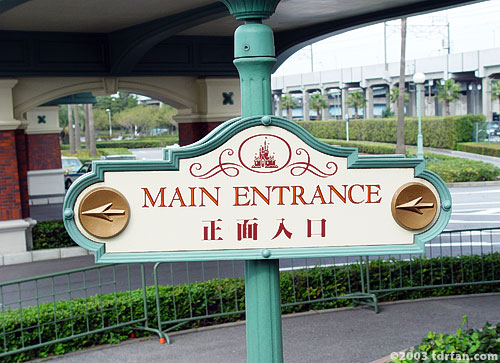
For the most part, the layout of Tokyo Disneyland Park mirrors its American counterparts: You walk through a main entrance and up Main Street to a central hub which branches out to the various lands of the park. As you would expect, the centerpiece of the park is a castle; in this case, Cinderella Castle. Despite the familiar layout, there are some obvious differences. Main Street (called "World Bazaar") is covered by a Plexiglas canopy. There is no steam train running around the perimeter of the Park; instead it runs around Adventureland. Frontierland is not called Frontierland, it's called Westernland. There's no New Orleans Square, although there is an area that looks like New Orleans Square but it is technically Adventureland. Fantasyland looks like Disneyland's Fantasyland did in the late 1970s. Tomorrowland is Spartan and sadly not very futuristic.
 One of the wonderful things about Tokyo Disneyland Park is that it is
meticulously maintained. The Park is over
43 years old now but you'd never
be able to tell, even on close inspection. The landscaping is groomed to
perfection. Rides and attractions are all as close to perfect as can be,
both cosmetically and functionally. Walkways, benches, and eating areas are
always spotless.
One of the wonderful things about Tokyo Disneyland Park is that it is
meticulously maintained. The Park is over
43 years old now but you'd never
be able to tell, even on close inspection. The landscaping is groomed to
perfection. Rides and attractions are all as close to perfect as can be,
both cosmetically and functionally. Walkways, benches, and eating areas are
always spotless.
Part of the reason that the Park is always so clean is that the staff does a great job of keeping it that way. I feel however—and this is just a personal observation—that the other reason is that Japanese people, by and large, are pretty neat and tidy themselves. Part of this is cultural, but the other part has to be simple necessity: if you lived in a country as densely populated as Japan* you'd have to be organized just to survive. One example of how the Japanese people help keep their park clean is that in Japan it's poor etiquette to walk and eat at the same time; this helps keep walkways free from popcorn and ice cream spills. (This is one Japanese tradition I occasionally break, as strolling around Disneyland while eating a box of popcorn is a small pleasure I have enjoyed all my life.)
Despite its similarities, Tokyo Disneyland Park is different enough that regardless of how many times you've visited Disneyland Park in California or Florida's Magic Kingdom, visiting Tokyo Disneyland Park for the first time will be fresh and exciting and wonderful. It was for me.
* Imagine taking half the population of the United States and cramming them into California—that's roughly the population density of Japan.